Danish Roast Chicken Recipe (Crispy Helstegt Kylling with Parsley)
Danish roast chicken stuffed with parsley and butter, roasted until the skin is crispy and served with creamy Danish brown sauce.
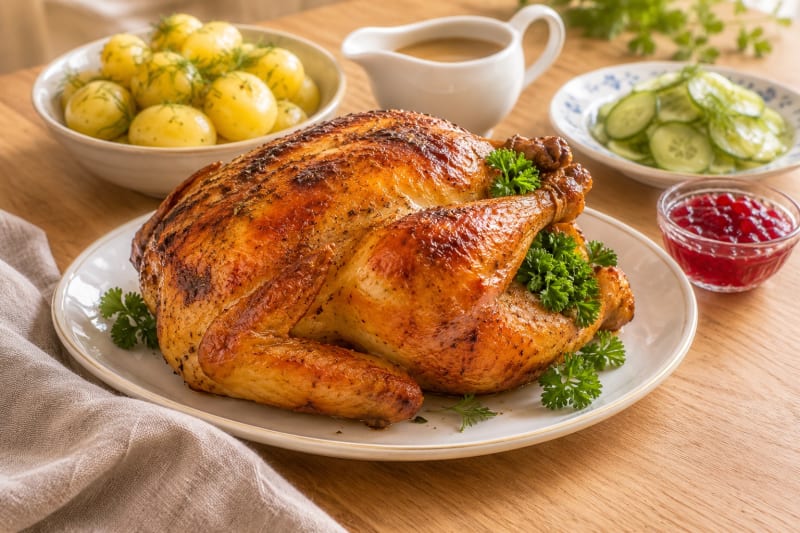
This Danish roast chicken recipe gives you the bird Danes have served for Sunday dinner for generations: a whole chicken stuffed with a fat bunch of curly parsley and butter, roasted until the skin is deep golden and crackly, then carved over a jug of creamy brown sauce. In Denmark it is called helstegt kylling med persille, which simply means "whole roasted chicken with parsley", and it is one of the most loved home dishes in the country.
Chicken was once a treat in Danish farmhouses, kept for holidays and guests, and the parsley-stuffed version became the classic way to make one bird feel festive. The idea is clever and very Nordic: the parsley and butter melt inside the cavity, steaming the meat from within so the breast stays juicy, while the pan juices pick up a fresh green flavour that later goes straight into the sauce. Nothing is wasted.
The secret to a really crispy skin is dryness. Salt the chicken and leave it uncovered in the fridge for at least an hour, or overnight if you can plan ahead. The salt draws moisture out of the skin, so it renders and blisters in the oven instead of turning soft. A short blast of higher heat at the end finishes the job, and a little sweet paprika gives the deep colour you see in Danish kitchens.
The brown sauce (brun sovs) is not optional for most Danes. It is built from the roasting juices, chicken stock and cream, thickened lightly with flour and finished with a spoon of redcurrant jelly for a gentle sweet edge. A few drops of kulør, a Danish gravy browning, make it glossy and dark. If you cannot find kulør, a teaspoon of soy sauce does the same job.
Swaps are easy. Flat-leaf parsley works if curly is not available, ghee or olive oil can replace the butter, and lingonberry or blackcurrant jelly can stand in for redcurrant. For a gluten-free sauce, thicken it with cornflour instead of plain flour.
Serve it the Danish way with small boiled new potatoes, agurkesalat (thin cucumbers in sweet vinegar), the brown sauce and a spoon of rhubarb compote or redcurrant jelly on the side. Leftovers make an excellent smørrebrød the next day.
Watch how it is made on our YouTube channel: https://youtube.com/shorts/zZ3e4Ug0rIs
Watch how it is made
Ingredients
- 1 whole chicken, about 1.6 kg
- 2 tsp flaky sea saltSubstitute: 1.5 tsp fine salt
- 1 tsp black pepper, freshly ground
- 1 tsp sweet paprika
- 60 g butter, softSubstitute: ghee or olive oil
- 60 g curly parsley, one large bunchSubstitute: flat-leaf parsley
- 100 ml water, for the roasting tray
- 300 ml chicken stock
- 100 ml whipping cream
- 1 tbsp plain flourSubstitute: 2 tsp cornflour for gluten-free
- 1 tsp redcurrant jellySubstitute: lingonberry jelly
- 1 tsp kulør (Danish gravy browning)Substitute: soy sauce
Method
- Dry and salt the chicken. Pat the chicken completely dry with kitchen paper, inside and out. Rub the salt all over the skin and inside the cavity, then leave it uncovered on a plate in the fridge for at least 1 hour, or overnight for the crispiest skin.
- Heat the oven. Take the chicken out of the fridge 20 minutes before roasting and heat the oven to 200°C (180°C fan). Pat off any moisture that has appeared on the skin.
- Stuff with parsley and butter. Push the whole bunch of parsley, stalks and all, into the cavity together with two thirds of the butter cut into small cubes. Tie the legs together with kitchen string so the stuffing stays inside.
- Season the skin. Mix the remaining butter with the paprika and pepper and rub it thinly over the breast and legs. Set the chicken breast-side up on a rack in a roasting tray and pour the water into the tray.
- Roast the chicken. Roast for about 65 minutes, basting once with the pan juices halfway through. Add a splash more water if the tray looks dry so the juices do not burn.
- Crisp the skin. Turn the oven up to 225°C (205°C fan) and roast for 10 more minutes until the skin is deep golden and crackly. The thickest part of the thigh should read 75°C, or the juices should run clear.
- Rest the chicken. Lift the chicken onto a board, tip the buttery parsley juices from the cavity into the roasting tray and let the bird rest uncovered for 10 minutes so the skin stays crisp.
- Make the brown sauce. Spoon most of the fat off the tray juices, then scrape them into a small pan with the stock and bring to a simmer. Whisk the flour into the cream until smooth, stir it into the pan and simmer for 5 minutes, whisking, until lightly thickened. Stir in the redcurrant jelly and kulør and season with salt and pepper.
- Carve and serve. Carve the chicken into legs, thighs and breast slices and serve with boiled new potatoes, cucumber salad, the hot brown sauce and redcurrant jelly on the side.
For the crispiest Danish roast chicken, salt it the night before and leave it uncovered in the fridge, as the dry skin is what turns crackly in the oven. Do not cover the bird with foil while it rests, because steam softens the skin. Keep the parsley stalks in the stuffing: they hold the most flavour. If the sauce gets too thick, loosen it with a splash of stock, and if it is too pale add a few more drops of kulør or soy sauce. Leftover chicken keeps for 3 days in the fridge and is lovely cold on rye bread with cucumber salad.
Frequently asked questions
What is Danish roast chicken called in Danish?
It is called helstegt kylling med persille, which means whole roasted chicken with parsley. Many Danes simply call it kylling med persille.
Why do Danes stuff chicken with parsley?
The parsley and butter melt inside the cavity and gently steam the meat, keeping the breast juicy and giving the pan juices a fresh herby flavour that goes into the brown sauce.
How do I get crispy skin on roast chicken?
Dry the chicken well, salt it and leave it uncovered in the fridge for at least an hour or overnight, then finish roasting at a higher temperature for the last 10 minutes and rest it uncovered.
How long do I roast a whole chicken at 200°C?
A 1.6 kg chicken needs about 65 minutes at 200°C plus 10 minutes at 225°C. Allow roughly 45 minutes per kilo and check that the thigh reaches 75°C.
What is kulør and what can I use instead?
Kulør is a Danish caramel-based gravy browning that gives brown sauce its dark, glossy colour. A teaspoon of soy sauce or a commercial gravy browning works as a substitute.
What do you serve with Danish roast chicken?
The classic sides are boiled new potatoes, agurkesalat (sweet pickled cucumber salad), creamy brown sauce and redcurrant jelly or rhubarb compote.