Peking Duck Recipe (Crispy Chinese Roast Duck at Home)
Peking duck recipe for a home oven: glossy, crackling skin, juicy meat, soft Mandarin pancakes and sweet bean sauce. Plus how to say it in Chinese.
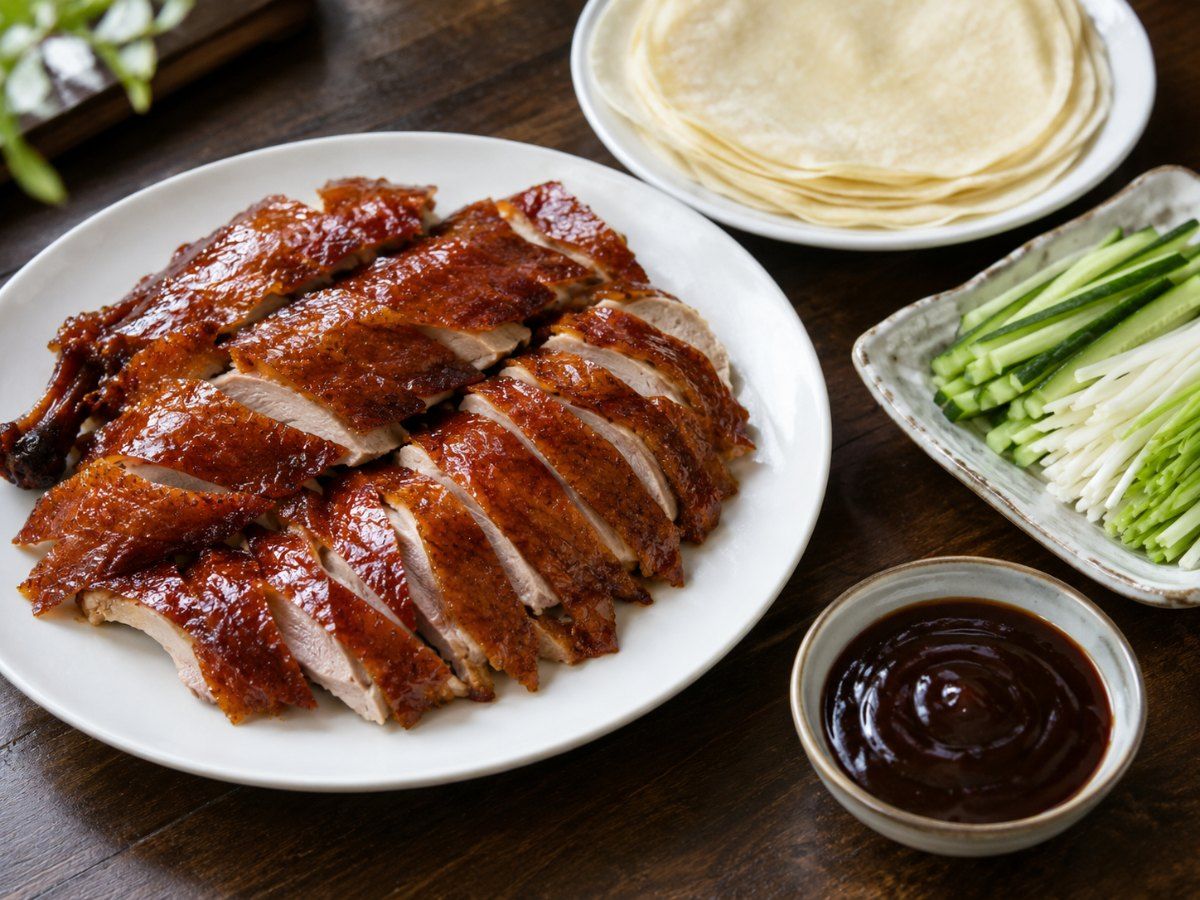
This Peking duck recipe shows you how to get that famous lacquered, glass-crisp skin from an ordinary home oven. The duck is scalded, brushed with a sweet vinegar glaze and left to dry in the fridge, then roasted until the skin turns deep mahogany and crackles under the knife. You wrap thin slices in soft Mandarin pancakes with sweet bean sauce, spring onion and cucumber, exactly the way it is eaten in Beijing.
Peking is the old English spelling of Beijing, and in Chinese the dish is called Beijing kaoya, which simply means Beijing roast duck. Roast duck was cooked in the capital's imperial kitchens for centuries, and old restaurants in the city made it their signature, roasting the birds in tall wood-fired ovens. Today it is the dish most visitors to Beijing go looking for, and a good restaurant still carves it at the table.
The whole secret is the skin. Restaurants pump air between the skin and the meat and hang the ducks in a breezy room, which is hard at home. Instead, this recipe uses three tricks. Pouring boiling water over the duck tightens the skin and starts melting the fat underneath. The glaze of maltose or honey and rice vinegar gives the rich red-brown colour. Then a full day uncovered in the fridge dries the surface until it feels like paper, which is what lets it crisp instead of steam.
Maltose is the traditional sugar, and you can find it in Chinese grocers, but honey works almost as well; it just browns a little faster, so keep an eye on the oven at the end. If you cannot find sweet bean sauce (tianmianjiang), hoisin sauce is the usual swap outside China. Store-bought frozen duck pancakes save time, but the homemade ones in this recipe take only flour, boiling water and a little sesame oil, and they are much softer.
Serve the skin first, on its own with a dip of sugar if you like, then the sliced meat with pancakes. Set out bowls of spring onion and cucumber batons so everyone can roll their own. Save the carcass: in Beijing the bones are often turned into a light duck soup to finish the meal.
Watch how it is made on our YouTube channel: https://youtube.com/shorts/Wy_Z0_efzgw
Watch how it is made
Ingredients
- 2200 g whole duck, thawed if frozen
- 2 tsp salt
- 1 tsp Chinese five-spice powder
- 1 tsp sugar
- 4 slices fresh ginger
- 3 spring onions, cut in half (for the cavity)
- 3 tbsp maltoseSubstitute: honey
- 2 tbsp rice vinegarSubstitute: Chinkiang black vinegar
- 1 tbsp Shaoxing wineSubstitute: dry sherry
- 60 ml hot water (for the glaze)
- 250 g plain flour (for the pancakes)
- 180 ml boiling water (for the pancakes)
- 2 tbsp toasted sesame oil
- 6 tbsp sweet bean sauce (tianmianjiang)Substitute: hoisin sauce
- 1 tbsp sugar (for the sauce)
- 6 spring onions, white parts cut into thin batons
- 1 cucumber, cut into thin batons
Method
- Prep the duck. Remove the neck and giblets, pull out the loose fat around the cavity and cut off the wing tips. Rinse the duck and pat it completely dry with kitchen paper.
- Season the inside. Mix the salt, five-spice and sugar and rub it all over the inside of the cavity only, not on the skin. Push in the ginger and halved spring onions, then close the opening with a skewer.
- Scald the skin. Set the duck on a rack in the sink and slowly pour a full kettle of boiling water over every part of it, turning it once. The skin will tighten and shrink, which is exactly what you want. Pat it dry again.
- Glaze the duck. Stir the maltose or honey, rice vinegar and Shaoxing wine into the hot water until dissolved. Brush it evenly over the whole skin, wait 5 minutes and brush on a second coat.
- Dry it in the fridge. Put the duck breast-up on a rack over a tray and refrigerate it uncovered for 24 hours, up to 48. The skin should feel dry and papery, like parchment, when it is ready. This step makes the crisp skin, so do not skip it.
- Roast it low. Heat the oven to 180°C (fan 160°C). Pour 2 cm of water into a roasting tray to catch the fat without smoking, set the duck on a rack above it breast-up and roast for 60 minutes.
- Crisp the skin. Turn the oven up to 220°C (fan 200°C) and roast for another 15 to 20 minutes until the skin is deep mahogany and crackly and the juices at the thigh run clear. Watch closely near the end, because the sugary glaze can burn quickly.
- Make the pancake dough. While the duck roasts, stir the boiling water into the flour with chopsticks, then knead into a smooth soft dough once cool enough to touch. Cover and rest for 30 minutes.
- Cook the pancakes. Roll the dough into a log and cut 16 pieces. Flatten two pieces, brush one with sesame oil, press them together and roll out thinly to about 18 cm. Cook in a dry pan for 30 to 40 seconds a side until puffed with light spots, then peel the pair apart and keep covered. For the sauce, warm the sweet bean sauce with the sugar and 1 tbsp sesame oil for 2 minutes.
- Rest and carve. Rest the duck for 10 minutes, then slice the skin off first into small pieces and carve the meat into thin slices. Spread a little sauce on a pancake, add duck, spring onion and cucumber, roll it up and eat right away.
Dryness is everything: if the skin still feels damp or tacky after a day, give it another 12 hours in the fridge, or point a fan at it for an hour before roasting. Choose a duck with no tears in the skin, because any hole lets fat and steam escape onto the surface and leaves soft patches. Keep the water in the tray topped up so the dripping fat never smokes, and pour off the rendered fat afterwards; it is perfect for roasting potatoes. The pancakes can be made a day ahead and re-steamed for 3 to 4 minutes until soft.
Frequently asked questions
What is Peking duck?
Peking duck is a famous roast duck dish from Beijing, China. The duck is glazed and dried so the skin roasts thin, shiny and crisp, then it is carved and eaten wrapped in thin pancakes with sweet bean sauce, spring onion and cucumber.
How do you pronounce Peking duck in Chinese?
In Mandarin it is 北京烤鸭, Beijing kaoya, said roughly bay-JING cow-YAH. Peking is just the older English spelling of Beijing.
Can you make Peking duck in a normal oven?
Yes. Scalding the skin, glazing it and drying the duck uncovered in the fridge for 24 hours copies what restaurant ovens do, and a two-stage roast at 180°C then 220°C crisps the skin well in a home oven.
What sauce is served with Peking duck?
In Beijing it is sweet bean sauce (tianmianjiang), a thick, savoury-sweet fermented wheat paste warmed with a little sugar and sesame oil. Outside China hoisin sauce is the common substitute.
Why is my Peking duck skin not crispy?
Almost always because the skin was not dry enough before roasting. Give the duck a full day or more uncovered in the fridge, avoid tearing the skin and finish the roast at a high temperature.
What is the difference between Peking duck and crispy aromatic duck?
Peking duck is roasted and the focus is on its thin, lacquered skin. Crispy aromatic duck, popular in Chinese restaurants in the UK, is steamed with spices and then deep-fried, so the meat shreds and the skin is crunchier and less glossy.