Mango Sticky Rice Recipe (Thai Khao Niao Mamuang)
Easy mango sticky rice recipe: steamed glutinous rice soaked in sweet-salty coconut sauce with ripe mango, just like a Bangkok street cart.

This mango sticky rice recipe gives you the most loved dessert in Thailand: chewy steamed glutinous rice soaked in warm, sweet and slightly salty coconut milk, served next to slices of cold, perfectly ripe mango. It needs only a handful of ingredients, but the method matters, and once you get it right it tastes exactly like the plates sold from street carts all over Bangkok.
In Thai the dish is called khao niao mamuang. Khao niao means sticky rice, and mamuang means mango, so the name is simply a description of the plate. It is a seasonal treat, because Thai mango season peaks from March to May, during the hottest part of the year. That is when vendors stack sweet golden Nam Dok Mai mangoes beside big baskets of steamed rice, and families eat it as an afternoon snack rather than only after dinner.
The key technique is that sticky rice is steamed, not boiled. You soak the rice for at least four hours so each grain softens all the way through, then steam it until it turns glossy and translucent. While it is still hot, you pour over a sweetened coconut milk with a good pinch of salt. The hot grains drink up the sauce and turn rich and tender while staying chewy. The salt is not optional: it is what makes the coconut taste rounder and the mango taste sweeter.
You need glutinous rice, sometimes sold as sweet rice or sticky rice. Jasmine rice and sushi rice will not work, because they do not have the same starch. Despite the name, glutinous rice contains no gluten, so this dessert is naturally gluten-free and vegan. For the mango, choose fragrant, fully ripe fruit that gives slightly when pressed. Honey or Ataulfo mangoes are the closest match to Thai varieties. A small spoon of rice flour or tapioca starch thickens the topping sauce, and crispy yellow mung beans or toasted sesame seeds add crunch.
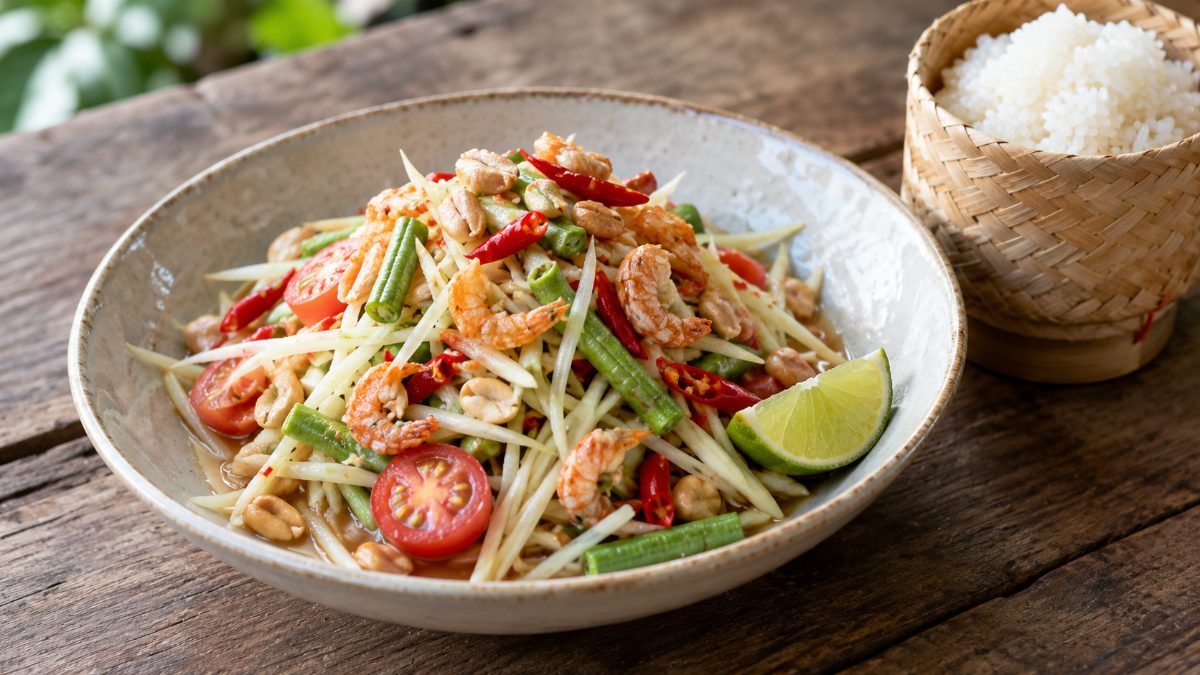
Serve the rice warm or at room temperature, never cold from the fridge, because chilled sticky rice turns hard. Spoon the thick coconut cream over the top just before eating. It is the perfect sweet ending after a fiery som tam.
Watch how it is made on our YouTube channel: https://youtube.com/shorts/fxkE-t8bVuc
Watch how it is made
Ingredients
- 300 g Thai glutinous rice (sweet rice)Substitute: any long or short-grain glutinous rice
- 400 ml full-fat coconut milk, divided
- 100 g white sugar (for the rice sauce)Substitute: palm sugar
- 1 tsp salt (for the rice sauce)
- 1 tbsp white sugar (for the topping)
- 0.25 tsp salt (for the topping)
- 2 tsp rice flourSubstitute: tapioca starch or cornstarch
- 2 tbsp water (for the flour slurry)
- 1 pandan leaf, knotted (optional)
- 3 large ripe mangoesSubstitute: Honey or Ataulfo mangoes
- 1 tbsp crispy fried mung beans or toasted sesame seeds
Method
- Rinse the rice. Wash the glutinous rice in cold water, swirling and draining 3 to 4 times until the water runs almost clear. This removes loose starch so the grains stay separate and chewy.
- Soak it. Cover the rice with plenty of cold water and leave it for at least 4 hours, or overnight. A grain should crush easily between your fingers when it is ready.
- Steam the rice. Drain well, spread the rice in a steamer basket lined with a damp cloth or muslin and steam over boiling water for 20 to 25 minutes. Flip the rice halfway so it cooks evenly. It is done when the grains look shiny and translucent with no white centres.
- Make the sweet coconut sauce. While the rice steams, warm 300 ml of the coconut milk with 100 g sugar, 1 tsp salt and the pandan leaf over low heat, stirring until the sugar dissolves. Do not let it boil hard, or the coconut milk can split.
- Soak the hot rice. Tip the hot rice into a bowl, pour over the warm sauce and stir gently. Cover and leave for 20 to 30 minutes so the grains absorb the coconut milk and turn rich and glossy.
- Cook the topping. In a small pan heat the remaining 100 ml coconut milk with 1 tbsp sugar and 1/4 tsp salt. Stir in the rice flour mixed with 2 tbsp water and simmer for 1 to 2 minutes until it thickens like pouring cream.
- Cut the mango. Peel the mangoes, slice the two cheeks off each side of the stone and cut them into thick slices. Keep the fruit chilled until serving for a nice warm-and-cold contrast.
- Plate it up. Press a mound of sticky rice onto each plate and lay the mango slices beside it. Spoon the thick coconut topping over the rice and sprinkle with crispy mung beans or sesame seeds.
- Serve warm. Eat the mango sticky rice warm or at room temperature on the same day. Do not refrigerate the rice before serving, because it turns hard and dry.
Always use glutinous rice, because jasmine or sushi rice will not give the chewy texture. Do not skip the salt in the coconut sauce; it is what makes the dish taste Thai rather than just sweet. If you have no steamer, set a sieve over a pot of simmering water and cover it with a lid. Leftover sticky rice can be wrapped and refreshed in the microwave with a splash of water for 30 to 60 seconds until soft again.
Frequently asked questions
How do you pronounce khao niao mamuang?
It is pronounced roughly cow-nee-OW ma-MOO-ung. Khao niao means sticky rice and mamuang means mango.
Can I make mango sticky rice without soaking the rice?
Soaking is strongly recommended. Unsoaked glutinous rice steams unevenly and stays hard in the middle. If you are short on time, soak in hot tap water for at least 1 hour, but 4 hours or overnight gives the best texture.
Can I use regular rice for mango sticky rice?
No. Jasmine, basmati and sushi rice do not have the starch that makes glutinous rice chewy and sticky. Look for bags labelled glutinous rice, sweet rice or sticky rice.
Is mango sticky rice gluten-free and vegan?
Yes. Glutinous rice contains no gluten despite its name, and the sauce is made with coconut milk, sugar and salt, so the classic recipe is both gluten-free and vegan.
What is the best mango for mango sticky rice?
Use fully ripe, fragrant mangoes with smooth, non-fibrous flesh. Thai Nam Dok Mai mangoes are traditional; outside Thailand, Honey or Ataulfo mangoes are the best match.
How do you store leftover mango sticky rice?
Keep the rice covered at room temperature for a few hours, or wrap it and refrigerate for up to 2 days. Reheat it in the microwave or steamer until soft, and cut fresh mango just before serving.