Lasagna Recipe (Classic Italian Lasagne alla Bolognese with Béchamel)
Classic lasagna recipe from Bologna: slow-cooked ragù, silky béchamel and Parmigiano layered and baked until golden. Plus how to say lasagne.
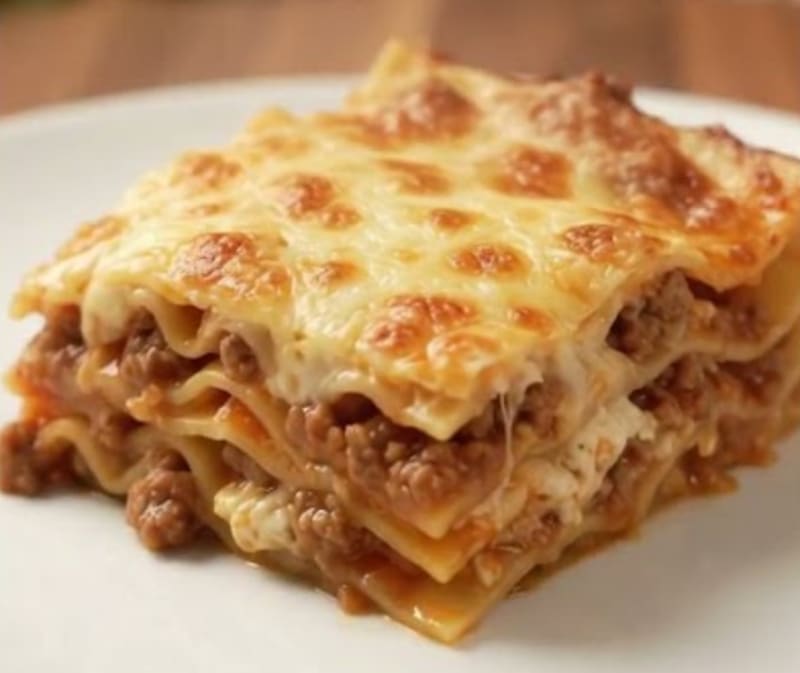
This lasagna recipe is the classic baked lasagne of Bologna: thin sheets of egg pasta layered with a slow-simmered meat ragù, creamy béchamel and plenty of Parmigiano Reggiano, then baked until the edges turn crisp and the top bubbles. It is the dish Italian families make for Sunday lunch and holidays, and once you make it this way the ricotta-heavy versions start to feel like a different meal.
The name comes from the Latin lasanum and the Greek laganon, words for a cooking pot and for flat sheets of dough. In Italy the dish is usually called lasagne, plural, because it is built from many sheets; one sheet is a lasagna. Emilia-Romagna, and Bologna in particular, made the version with ragù and béchamel famous, while southern Italy has its own lasagne with ricotta, tiny meatballs and boiled eggs for Carnival.
The flavour comes from patience rather than spice. The ragù starts with a soffritto of onion, carrot and celery cooked gently in butter and oil, then minced beef and pork are browned, splashed with white wine and simmered with a little tomato and milk for around two hours. The milk softens the acidity and makes the sauce rich and round. Béchamel adds creaminess and holds the layers together, so the lasagna cuts into clean squares instead of sliding apart.
You can swap the pork for more beef, or use only beef if you prefer. Dried no-boil sheets work well if you add an extra ladle of béchamel, because they need liquid to soften. Grana Padano is a cheaper alternative to Parmigiano Reggiano, and a little mozzarella on top is not traditional in Bologna but gives a stretchy finish many people love. Make the ragù a day ahead and the whole dish becomes easy to assemble.
Serve lasagna after it rests for at least 20 minutes, with a crisp green salad dressed with olive oil and lemon, and a glass of Sangiovese or Lambrusco. Leftovers taste even better the next day.
Watch how it is made on our YouTube channel: https://youtube.com/shorts/GPsrmwBMirw
Watch how it is made
Ingredients
- 2 tbsp olive oil
- 30 g butter (for the ragù)
- 1 onion, finely chopped
- 1 carrot, finely chopped
- 1 celery stalk, finely chopped
- 500 g minced beefSubstitute: all beef, or half beef and half veal
- 250 g minced porkSubstitute: more minced beef
- 150 ml dry white wineSubstitute: beef stock
- 2 tbsp tomato paste
- 400 g passata (strained tomatoes)
- 250 ml whole milk (for the ragù)
- 250 ml beef stock
- 1.5 tsp salt, plus more to taste
- 0.5 tsp black pepper
- 70 g butter (for the béchamel)
- 70 g plain flour
- 1000 ml whole milk (for the béchamel)
- 0.25 tsp ground nutmeg
- 500 g fresh egg lasagne sheetsSubstitute: dried no-boil sheets plus an extra ladle of béchamel
- 120 g Parmigiano Reggiano, finely gratedSubstitute: Grana Padano
Method
- Cook the soffritto. Heat the oil and 30 g butter in a large heavy pot over medium-low heat. Add the onion, carrot and celery with a pinch of salt and cook gently until soft and sweet but not browned.
- Brown the meat. Turn the heat up to medium-high, add the beef and pork and break them up with a wooden spoon. Cook until the meat loses its pink colour and starts to sizzle and brown in places.
- Add wine and tomato. Pour in the wine and let it bubble until it mostly evaporates. Stir in the tomato paste for a minute, then add the passata, stock, salt and pepper.
- Simmer the ragù. Pour in the 250 ml milk, bring to a bare simmer, partly cover and cook very gently for about 2 hours, stirring now and then and adding a splash of water if it gets dry. It is ready when thick, glossy and spoonable.
- Make the béchamel. Melt 70 g butter in a saucepan, whisk in the flour and cook for 1 minute. Slowly whisk in the warm milk and keep whisking over medium heat until it thickens like custard. Season with salt and nutmeg.
- Prepare the pasta. Heat the oven to 190°C (375°F). If your fresh sheets are thick, blanch them for 30 seconds in salted boiling water and lay them flat on a clean towel. No-boil sheets go in straight from the box.
- Layer the lasagna. In a 23 x 33 cm baking dish spread a little béchamel, then add a layer of pasta, a layer of ragù, a thin layer of béchamel and a handful of Parmigiano. Repeat for 5 to 6 layers, finishing with béchamel and a generous blanket of cheese.
- Bake until golden. Bake uncovered until the top is golden with darker crispy edges and the sauce bubbles around the sides. Cover loosely with foil if it browns too fast.
- Rest and slice. Let the lasagna rest for 20 minutes so the layers set, then cut into squares and serve with extra Parmigiano.
Make the ragù a day ahead: it deepens in flavour overnight and the lasagna then takes only 20 minutes to assemble. Keep the ragù thick, because a watery sauce makes a soggy lasagna. Lasagne is pronounced la-ZAHN-yeh. You can assemble the dish, cover it and refrigerate it for up to 24 hours before baking; add 10 to 15 minutes to the baking time. Leftovers keep 4 days in the fridge, and baked slices freeze well for up to 3 months.
Frequently asked questions
How do you pronounce lasagne?
In Italian it is la-ZAHN-yeh, and lasagna (one sheet) is la-ZAHN-yah. The gn sounds like the ny in canyon.
Is authentic Italian lasagna made with ricotta?
The classic lasagne alla Bolognese uses béchamel, not ricotta. Ricotta appears in some southern Italian versions, such as Neapolitan Carnival lasagna, and in many Italian-American recipes.
How many layers should lasagna have?
Most home lasagnas have 4 to 6 layers of pasta. Thin fresh sheets let you build more layers, which gives the classic tall Bolognese look.
Do I need to boil lasagna noodles first?
No-boil dried sheets and thin fresh sheets can go straight in, as long as there is enough sauce to soften them. Thick fresh sheets and regular dried sheets are best blanched first.
How long should lasagna bake and at what temperature?
Bake at 190°C (375°F) for about 35 to 40 minutes, until golden and bubbling. A dish assembled ahead and chilled needs 10 to 15 minutes more.
Why is my lasagna watery?
Usually the ragù was not cooked down enough, or the béchamel was too thin. Simmer the sauce until thick, and always let the lasagna rest 20 minutes before cutting.